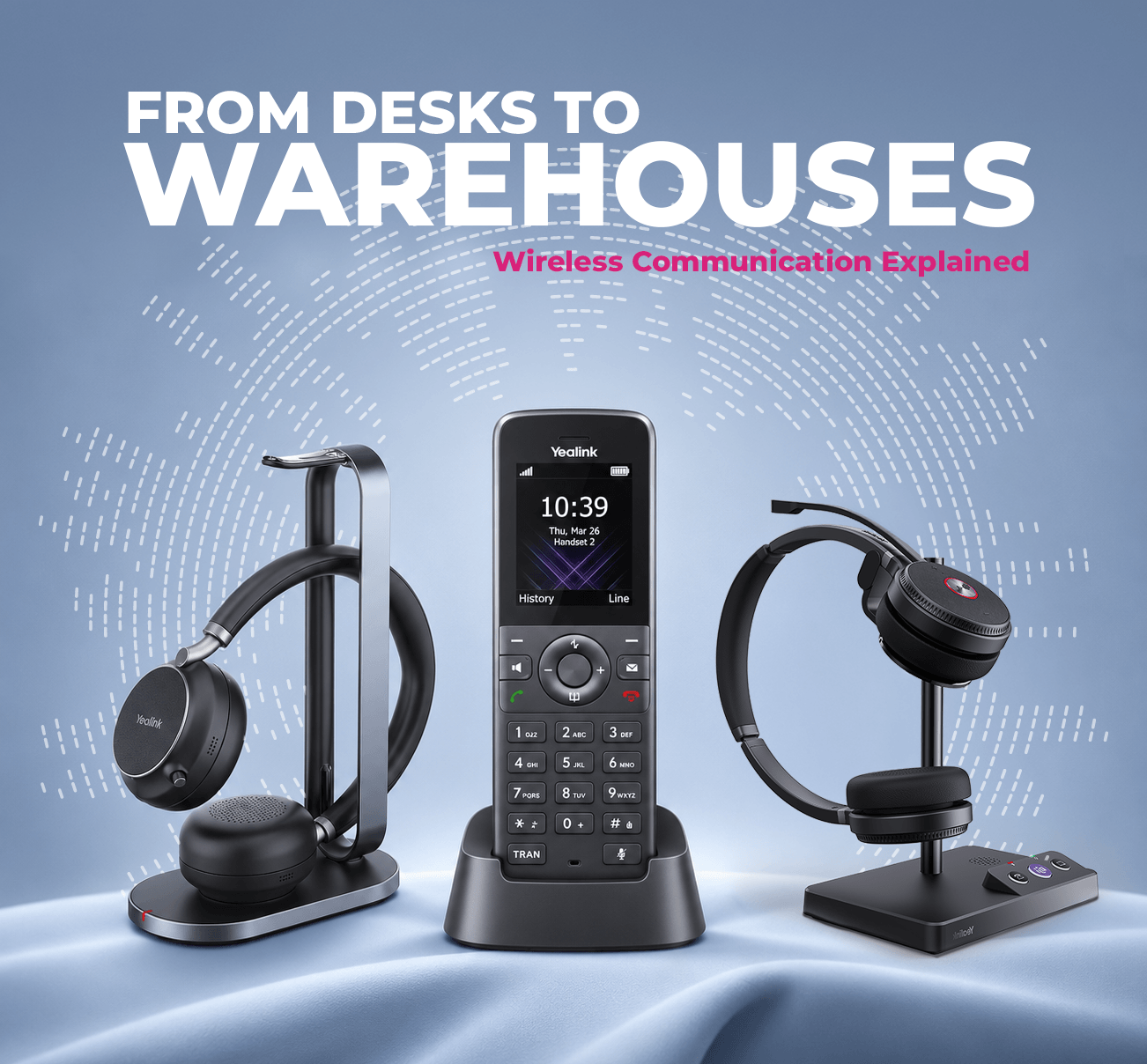
Go Wireless & Go Further: How Yealink Empowers Wireless Communication Across Key Industries
When fitting out a workplace with cordless phones or headsets, WiFi isn't your only option, and often isn't your best one.
From DECT base stations built for multi-floor roaming to ruggedised handsets made for factories, matching the right wireless technology to your environment prevents dropped calls and dead zones. Here is a quick guide to how these systems differ and which Yealink products suit your sector
Business Phones: Wired vs DECT vs WiFi
When choosing a business phone system, it's important to consider how employees work and whether they need to move around while taking calls.
| Technology | How it works | Best suited for |
| Wired IP Phones | Connect directly to a network using an Ethernet cable. | Desks, reception areas and fixed workstations. |
| DECT Phones | Connect cordless handsets to dedicated base stations. | Employees moving between rooms, floors or departments. |
| WiFi Phones | Connect compatible handsets through a workplace WiFi network. | Mobile staff in environments with reliable WiFi coverage. |
Unlike WiFi phones, DECT handsets communicate through dedicated base stations rather than relying on the workplace's WiFi network.
But even within DECT systems, there's another important difference to consider.
Single-Cell vs Multi-Cell DECT
Not every workplace needs the same level of coverage.
Single-cell DECT uses one base station to connect compatible cordless handsets, making it a practical choice for smaller offices, shops and other compact workplaces.
Multi-cell DECT, on the other hand, uses multiple base stations to extend coverage across larger buildings. When properly configured, compatible handsets can move between coverage areas without interrupting an active call.
For businesses operating across multiple floors, departments or buildings, this additional coverage can make a big difference.
Which Yealink Products Are Best Suited to Your Industry?
Hospitality: Keeping Every Floor Connected
From reception to housekeeping, hotel teams are constantly moving between floors and departments. Staying connected shouldn't mean having to return to a desk every time a call comes through.
Our pick: Yealink W90 Multi-Cell DECT System
Designed for larger environments, the Yealink W90 uses multiple base stations to extend coverage across a building. With seamless roaming and call handover, compatible handsets can move between coverage areas without interrupting an active conversation.
Compatible handsets include the Yealink W73H for everyday communication or the ruggedised W57R for more demanding environments.
Healthcare: Clear Communication Across Departments
In hospitals, clinics and care homes, clear communication is essential, particularly when staff need to remain mindful of patients and quieter environments.
Our pick: Yealink W57R
The Yealink W57R is a ruggedised DECT handset offering noise reduction and vibration alerts. Its vibration function can help staff receive notifications discreetly, while noise reduction improves call clarity in busier departments.
The W57R can be paired with the W70B single-cell base station for smaller facilities or a W90 multi-cell system for coverage across larger buildings and departments.
Retail: From Shop Floor to Stockroom
Whether checking stock availability or contacting colleagues, retail staff need to stay connected without being tied to one location.
Our pick: Yealink W70B DECT Base Station
The Yealink W70B is a single-cell DECT base station supporting up to 10 compatible handsets and 20 simultaneous calls.
For smaller retail environments, it provides a practical way to connect staff across the shop floor, stockroom and office, provided the areas are within coverage.
When paired with the Yealink W73H handset, it's available as the W73P cordless phone system, providing both the base station and handset in one package.
Larger stores with more demanding coverage requirements may benefit from a multi-cell system instead.
So, which Yealink products are best suited to different working environments?
Hospitality: Keeping Every Floor Connected
From reception to housekeeping, hotel teams are constantly moving between floors and departments. Staying connected shouldn't mean having to return to a desk every time a call comes through.
Our pick: Yealink W90 Multi-Cell DECT System
Designed for larger environments, the Yealink W90 uses multiple base stations to extend coverage across a building. With seamless roaming and call handover, compatible handsets can move between coverage areas without interrupting an active conversation.
Warehousing & Manufacturing: Built for Tougher Conditions
Metal shelving, machinery, dust and background noise can all create challenges for wireless communication.
Our picks: Yealink W57R vs W59R Pro
For everyday warehouse environments, the Yealink W57R offers IP54 protection against dust and water splashes alongside built-in noise reduction.
For tougher industrial conditions, the Yealink W59R Pro steps up to IP67 protection for greater resistance to dust and water, while also adding Bluetooth connectivity for use with compatible wireless headsets.
Offices & Hybrid Working: Choosing the Right Wireless Headset
So far, we've looked at cordless phones and DECT systems for employees moving around their workplaces. But what about employees taking calls through laptops, smartphones or desk phones?
For office and hybrid workers, wireless headsets offer greater flexibility. But should you choose Bluetooth or DECT?
Bluetooth headsets are ideal for hybrid workers who regularly switch between devices, such as laptops and smartphones. They're portable, versatile and well suited to those working across multiple locations.
DECT headsets are better suited to busy office environments where a longer wireless range and reliable connection are essential. They allow users to move further away from their desks while staying connected, making them particularly useful for call centres and employees who spend much of their day on calls.
Here are our top Yealink headset picks for both:
Our picks: Yealink BH70 vs WH64
The Yealink BH70 uses Bluetooth connectivity, making it suitable for employees switching between laptops and smartphones. Its microphone noise cancellation also helps keep conversations clear in busy environments.
The Yealink WH64 combines DECT and Bluetooth connectivity, offering more options for employees using multiple compatible devices. Its DECT mode also provides extended wireless range for moving around the office while taking calls.
The difference? Choose the BH70 for flexible Bluetooth-based working, or the WH64 if you need both DECT and Bluetooth connectivity.
Choosing the Right Wireless Setup
Before selecting a wireless communication solution, there are a few things worth checking:
- Coverage: How large is the building, and are there walls or obstacles that could affect the signal?
- Users: How many handsets and simultaneous calls need to be supported?
- Environment: Does the workplace require ruggedised devices, vibration alerts or noise reduction?
- Compatibility: Will the equipment work with existing phone systems and communication devices?
- Expansion: Could additional users or coverage areas be needed in the future?
Remember, DECT base stations, cordless handsets and wireless headsets all serve different purposes, so it's important to consider how the devices will work together.
Go Wireless, Go Further
Wireless communication isn't one-size-fits-anall. Hotels, warehouses and hybrid offices each bring their own requirements and challenges.
Whether it's a multi-cell DECT system for a large building, a ruggedised handset for demanding environments or a Bluetooth headset for flexible working, choosing the right equipment can make everyday communication easier.
With a range of cordless phones, DECT systems and wireless headsets, Yealink offers communication solutions for workplaces of all shapes and sizes.
Speak to our team for advice on choosing the right wireless technology for your workplace!